Why do some people get carsick and others don't?
Knowing the risk factors and treatment options may help prevent a stinky vomit disaster in your vehicle.
Jen Parkes' early travel blogging trips to Fiordland were seven hours on the road with a baby who wasn't even walking yet.
But with a travel-writing, photography-toting mum who's covered most of the South Island and 40 countries, her three children (now aged between 7 and 12) learned to take life on the road in their stride.
They rarely get sick while travelling, but Parkes knows the warning signs. The moment a small voice pipes up with "I don't feel so good," the mum radar switches on.

Windy roads can increase the chances of motion sickness. (file images)
Unsplash / Getty Images
Once, she was halfway through Lewis Pass with nowhere to pull over when it happened.
"If you're clever, you would take an ice cream container with a lid, you need something with a lid, because otherwise someone has to hold it and look at that."
Thankfully, the family has dodged any full-scale vomit disasters so far. She suggests, if you know your kid is prone to carsickness, pack something that's easy to rinse out.
What makes us car sick?

The conflict of signals from sitting down while in a moving vehicle may be why we experience motion sickness. (file image
Unsplash / Gonard Fluit
Our bodies rely on three systems to figure out where we are in space: proprioception (the pressure and movement signals from our joints and muscles), the vestibular system in the inner ear (our balance centre), and our vision.
When those systems send mixed messages (as may happen when you're sitting in a moving car), motion sickness can kick in, Balance Works vestibular physiotherapist Rebekah Miller explains.
"It's quite a complex interplay between what your eyes are saying, what your inner ear is saying, and what your body is saying."
Heat, windy roads, stop-start traffic, eating right before you leave, or even eating while on the move can all tip things in the wrong direction, she adds. And the longer the journey, the more likely someone hits their limit.
So why do some people sail through without issues?
Genetics may play a role, Miller says, along with how much movement you were exposed to as a child. Kids who loved spinning around, swinging, or rough-and-tumble play may have developed a more resilient sense of motion.

Kids who are used to being spun around from a young age may be less sensitive to motion sickness, Rebekah Miller says. (file image)
Unsplash / Getty Images
Those who experience migraines may also be more prone to motion sickness — possibly linked to lower serotonin levels, she says. And just like migraines, certain smells can add to that motion sickness stimulus.
Can we avoid it?
Parkes says the worst-case scenario is getting vomit on a car seat — the smell, the stain, the never-ending scrubbing. So prevention matters.
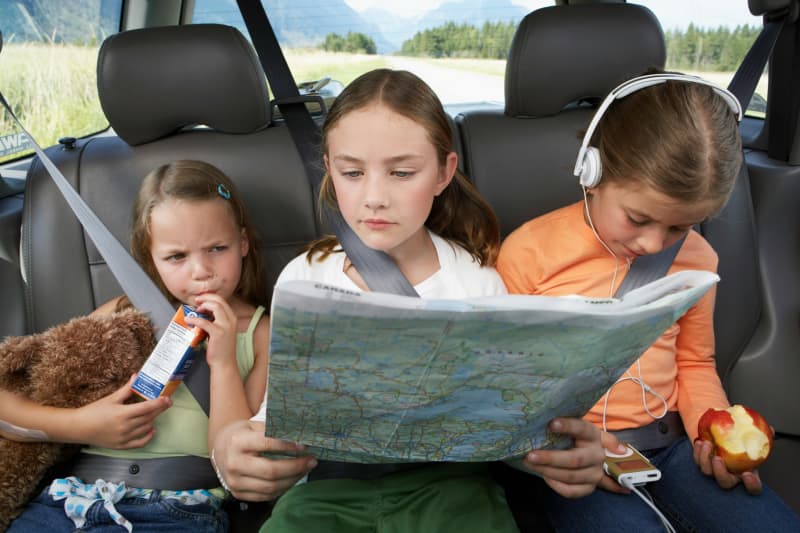
Some old-school tips still hold up: looking at the horizon, avoiding reading or using screens, and not travelling on an empty stomach (or a too-full one), Miller says.
Parkes has learned her kids’ triggers and has hacks in place: letting them rest after a drink, slowing down on windier roads to avoid the side-to-side swinging, and letting the more sensitive ones sit in the middle of the back seat for a clearer view.
"They say higher vehicles are better … and I definitely think that's true, I feel like I've had more car sickness in my vehicle that's more a car [than the four-wheel drive]."
Miller suggests holding a frisbee and pretending you're driving along too - in theory that should decrease motion sensitivity.
For back-seat travellers, those quirky motion-sickness glasses that give your eyes extra feedback might help, she says, though research on them may still be out.
Acupressure wristbands get mixed reviews. Parkes' daughter found them helpful — maybe placebo, maybe not. Miller says some of her dizzy and nauseous patients also report good results from using them.
What about treatment?
Several over-the-counter and prescription medications can help, some sedating (like cyclizine) and some more anti-nausea focused (like ondansetron). Miller notes that if you're using antihistamine-based options, it's worth taking a dose the day before travel as well.
She also points to research showing that ginger can reduce symptoms. (Consult your healthcare provider on natural remedies to be sure they're right for you.)
If you're a repeat offender who's tired of it, Miller says with the right exposure and help from a vestibular physio, people can retrain their system and rehabilitate from motion sickness altogether.


