Wuthering Heights is an absolute mess
It's a worrying sign when the scenes centred on a film's hero feel like its worst.
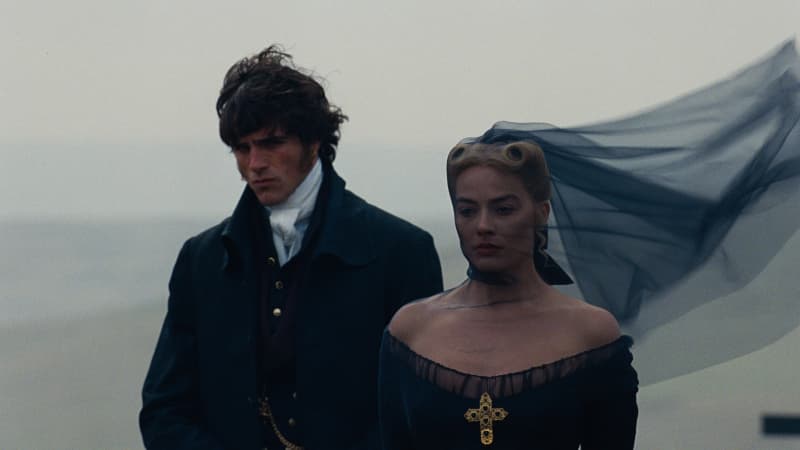
The problem with director Emerald Fennell'sWuthering Heights isn't how little it resembles its source material. Plenty of cinematic masterpieces look nothing like the books they're based on.
The problem is that it's a mess of a film.
It takes Emily Brontë's gothic romance, jams in a limp bodice-ripping plot using two of the hottest Australians in Hollywood, wraps it in the veneer of a fairytale, adds mild hints of horror, and turns the melodrama up several notches past sensible.
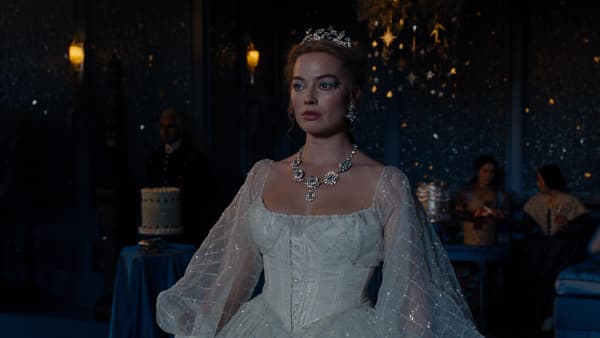
Margot Robbie, lead actress and producer of the film.
Warner Bros. Pictures
The product is a chaotic adaptation that tries a lot and delivers very little. The drama is saccharin, the sex isn't sexy and the laughs are far too sporadic as the tone swings furiously without much to pull it together.
Wuthering Heights - for those who aren't fans of the 19th century classics - is the tale (very roughly speaking) of Catherine Earnshaw, the daughter of landed gentry who marries a wealthy neighbour instead of her impoverished, life-long paramour, and adopted brother, Heathcliff. The decision sets into motion a cycle of revenge, love, regret.
If you’re worried you might miss some of the book's psychological undertones in Fennel's (Saltburn, Promising Young Woman) film, don't fret, because most of the characters will tell you exactly what they're thinking most of the time.

Film Review: Is "Wuthering Heights" worth seeing?
Lead actress and producer Margot Robbie (Barbie, I, Tonya) is usually a master of these kind of big performances. But here, whatever element turns over-the-top acting into gold is missing. From her first lines as a naive Cathy, to a critical exchange in which she fires her maid while dressed like a Disney villain, it all comes out a bit corny and inauthentic. Her gasp as Heathcliff breaks a chair would raise eyebrows on a sitcom.
Like much of the film, part of the problem is it's not clear if Cathy is being played for satire or authenticity in any given moment. It's a worrying sign when many of the scenes centred on a film's hero feel like its least convincing.
It's a relief, then, when Alison Oliver (Saltburn, The Order) turns up for a handful of moments as the meek Isabella Linton, suggesting the film might be riotously funny - and quite spooky - if it had committed to it.
As the brooding, dark horse Heathcliff, Jacob Elordi (Priscilla, Frankenstein) only really has one note to hit, but he hits it a lot and pretty well. Elordi's performance is three-quarters in his scowl, to the point that rare moments he whips out a smile feel rewarding. He betrays the fact that the film works best when it's not drowning in dialogue.
Meanwhile, there's plenty of sex thrown in, a provocative addition to a very sexless novel.
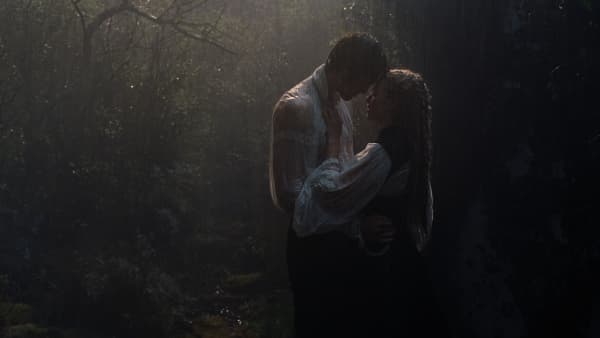
There's plenty of steamy scenes.
Warner Bros. Pictures
It's also a choice that's meant the film has been sold as a bonkbuster, probably a sensible marketing move when you have the likes of Robbie and Elordi leading your cast and going on a full-on charm offensive to sell it.
And none of it feels out of place, per se, but - apart from a few daring fragments - it's all quite restrained and lacking the tension you'd expect. It's unlikely to startle anyone who has sat through an episode or two of Outlander.
All that said, Wuthering Heights as a whole is undeniably the stylistic vision of an auteur.
It's hauntingly lit and aggressively colour-coded to the point of looking overwhelming.
The sets pull off eye-catching tricks of perspective and create surreal spaces. It evokes the feeling of a fable, another element the film hints at and never latches fully onto.
The costumes, too, are outlandish, decadent, fun and deliberately anachronistic - as is much of the music. This will all be polarising.
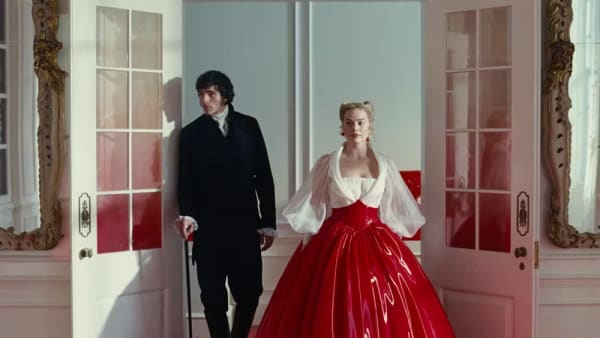
The costumes and music in Wuthering Heights will be polarising.
Warner Bros Pictures
But there are real moments of visual beauty sprinkled throughout. And of comedy.
When Catherine goes to visit her alcoholic father, she finds his body in a room where bottles are stacked in preposterous piles some two metres high on each side of him.
It's one of several genuinely funny, silly sight gags and points to a comedic heart and a more satirical tone that the film buries under layers of overwrought debris.
After more than 30 attempts to adapt Wuthering Heights for screen, and plenty of other period pieces treading similar territory, it's hard to figure out exactly why the latest is a version that needed to be made.
Emerald Fennell's film tries to do a lot, with all of it having been done better elsewhere.
Boris Jancic is a member of RNZ's digital team and reviews films.

