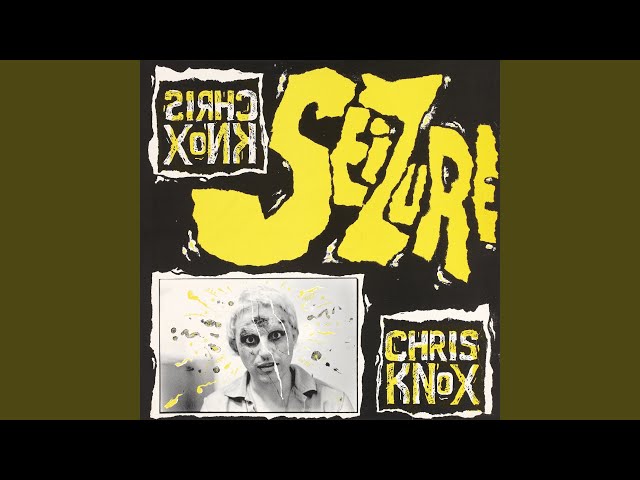
Essential New Zealand Albums: Chris Knox – Seizure
Nick Bollinger explores the work of one-of-a-kind musician Chris Knox, with a particular focus on his 1989 solo album Seizure.

Before suffering a serious stroke in 2009, Chris Knox was one of our most prolific and provocative music-makers.
It might say something about the nature of New Zealand that a person can go from being an iconoclast to a household name without having fundamentally changed anything about who they are or what they do.
Or does that just say something about the artist that is Chris Knox?
Chris Knox - Seizure

Chris Knox in 1996.
Barbara Ward (private collection)
Knox had spent more than a decade alternately entertaining and terrorising his audiences when his song 'Not Given Lightly' first appeared in 1989.
It was a track on his album Seizure and went on to become one of this country’s favourite wedding songs, as well as the soundtrack to a long-running television ad for a well-known brand of bread.
But while 'Not Given Lightly' represents just one facet of his work, Seizure isn’t a bad place to start for a broader appreciation of this unique New Zealand voice.
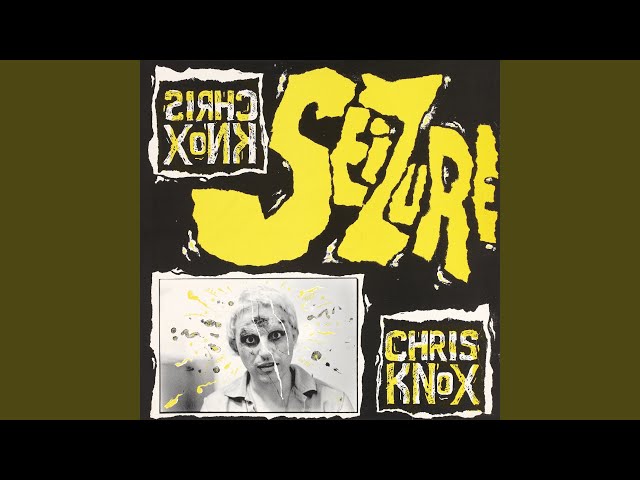
On the 1989 album, you’ll find all the elements that characterised Knox’s music throughout his career.
There's lots of blaring barre chords and fuzz tone guitar, and songs that speak plainly, sometimes humorously, other times shockingly, about the human condition, all wrapped in the lo-tech DIY production that Knox favoured as a matter of principle.
But there’s also a strong melodic element to his music which harks back to the '60s pop he grew up with, especially that of The Beatles, as you can hear in 'Face Of Fashion', the album’s opening track.

Chris Knox in the original album cover of 'Seizure'.
Flying Nun
Interestingly, while Knox is regarded as the pioneer of home-recording, much of Seizurewas, in fact, made in conventional studios – though not necessarily in a conventional way.
With a busy tape loop and barre chords played on a fuzz-tone guitar, ’Statement Of Intent’ articulates his position in terms of the music business.
'The New Zealand music industry just don’t have a clue/they have a low (or no) opinion of poor geeks like me and you…' the song begins, while in the chorus he sings: ‘I won’t be led astray/I won’t be damned/I won’t be held in thrall by your multi-national hand’.
In the song he calls 'Voyeur', Knox gestures towards a full-scale pop production with little more than his own multi-tracked voice. At times, he seems to be suggesting parts with his vocals that one can imagine played by a whole range of other instruments.

Chris Knox in a promo shot for the Beat album, 2000.
AudioCulture
For Knox, making music was always more than just entertainment. It was personal expression and a platform for his own obsessions and fascinations, which weren’t the typical stuff of songs.
One of his recurring fascinations is with body parts and bodily functions. You could call it grotesque realism. It’s as though he’s holding a mirror up to humanity and saying, ignore the images you see on television, billboards or magazine covers: this is what we really look like, how we think, and who we really are.

Chris Knox with his Bolex camera filming ‘Turning Brown and Torn in Two’ in Auckland, 1983.
Alec Bathgate (private collection)
Yet more often, he turns the mirror on himself.
Knox is epileptic, a fact he references in the album’s title. And he evokes the experience of a seizure, and more broadly discusses his feelings about his own epilepsy, in 'Grand Mal'.
But his concern with bodies and their functions also leads him to thoughts about gender and the roles that conventions around gender impose on us.
In 1989, there weren’t many people writing songs like 'The Woman Inside of Me', or the starkly titled 'Rapist’. If he is essentially declaring himself a born-again feminist here, he is also acknowledging the potential predator within.

Chris Knox performing at the Mainstreet Cabaret on Auckland's Queen Street.
Murray Cammick
The other side of these dark ruminations is 'Not Given Lightly’, not only his best-known song but surely up there with 'Pōkarekare Ana' as one of Aotearoa’s greatest love songs.
Never one to settle for glib sentiment, in the song’s closing verse, he memorably sings that writing a love song wasn’t easy and that he may never write another one.
But in fact, Seizure does have other love songs. And through the wall of looped percussion and fuzzed guitar of 'Filling Me' you will hear him declare that the changes romantic and domestic partnership have imposed on him have ultimately made him a better person.