

Prime Minister Christopher Luxon in Parliament. (File pic) Photo: VNP / Phil Smith
Prime Minister Christopher Luxon has made a personal explanation in the House on Tuesday night, after he stated incorrectly the government was automatically extending visas for people in New Zealand affected by the war in Iran.
The Greens co-leader said he "snuck" into the House "late last night" to correct the record and it shows he's "not across his brief".
In Question Time on Tuesday, Swarbrick asked Luxon if the government would commit to automatically extending visas for people who are in New Zealand now whose home countries have been affected by the war, as happened in the context of the invasion of Ukraine in 2022.
Luxon responded saying, "I understand that we are doing that, and the Minister of Immigration will continue to take advice on that too."
Follow updates with RNZ's blog
That was in contradiction to what his Immigration Minister Erica Stanford had said earlier that day, where she advised anyone who might be affected by the conflict to contact Immigration New Zealand.
"If they contact Immigration, we will be really pragmatic about making sure that they remain legally in New Zealand."

Photo: RNZ / Mark Papalii
She said it would be considered on a case-by-case basis, and the current visa that may be expiring could be extended.
Swarbrick was questioning the accuracy of Luxon's correction, and whether Ukrainians had received a blanket extension in 2022.
But the Prime Minister doubled down on that on Wednesday afternoon, saying he was advised it wasn't an "automatic extension".
Deputy Prime Minister David Seymour also said it should be considered on a case-by-case basis, and is cautious of applying blanket open immigration visas.
"We should always reserve the right to say, being in New Zealand, if you're not born here, is a privilege."
Earlier this week the Prime Minister admitted he "misspoke" when he said New Zealand supported "any actions" to prevent Iran having nuclear weapons.
Swarbrick said it's disconcerting to have a leader of New Zealand talking about things that are "currently so much of a powder keg" and every time he opens his mouth "we have no idea how that is going to place our country in the context of the very tense international relations at play".
"He simply does not seem to understand the weight of the things that he is talking about, or the substance or logic that sits behind them."
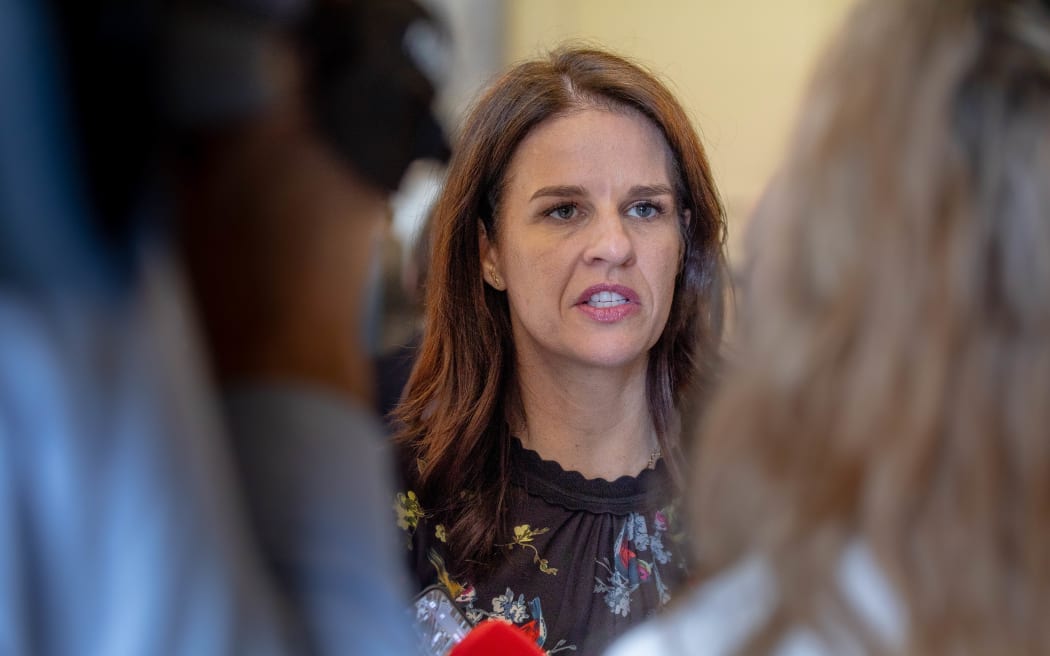
Photo: RNZ / Mark Papalii
Swarbrick said on Wednesday the Prime Minister had effectively said a blanket extension was happening when "we know it wasn't happening".
"So [the Prime Minister] then snuck into the house at 9:02pm I believe, late last night, to correct the record and to say that there was a case-by-case process, which we all already knew, available to those people."
At 9.03pm on Tuesday night, Luxon sought leave to make a personal explanation.
"To be perfectly clear, Immigration New Zealand has a well established process for international conflicts, and will facilitate and take a pragmatic approach to visa renewal when people are unable to return home," he explained.
"This was not an automatic process in the context of the invasion of Ukraine, and decisions will continue to be taken on individual visas."
Swarbrick told RNZ he also "misspoke" or "got his correction incorrect" when he said there wasn't a blanket extension applied during the war in Ukraine.
"We have it in black and white from a Cabinet paper," she said.
The paper stated Cabinet agreed to "extend by 12 months the visas of all Ukrainians onshore whose temporary visas were due to expire by the end of 2022".
She said the extension meant people didn't have to go through an arduous "case-by-case" basic to have them extended.
Swarbrick said she was now expecting the Prime Minister to have to "correct his correction".
She said politicians were human beings, "all of us will screw up, we will stumble over our words, we will also make mistakes."
"But I think there is quite a substantive difference between that and what the Prime Minister has modelled time and again, but very evidently over the last few days, which is that he is not across his brief."

Photo: RNZ / Mark Papalii
A spokesperson for the PM said in a statement: "Ukrainians caught in New Zealand on temporary visas when Russia initially invaded Ukraine had to apply to Immigration New Zealand for an extension on a case-by-case basis. That is currently the same situation for Iranians.
"The process for Ukraine extensions has changed multiple times as the conflict has dragged on.
"It is early days for the Iran conflict and the Immigration Minister is monitoring the situation."
On Wednesday afternoon, Luxon told reporters his office was working with Immigration New Zealand, and "all I can say to you" is the advice he received is that it wasn't automatic.
Asked whether Cabinet papers shouldn't be trusted, he said "I'm just telling you what I've been advised."
Seymour said the previous government did do blanket extensions, "and I"m not sure that was always the best thing to do."
"Immigration should be done on the merits of the case."
He's cautious of a blanket approach to immigration visas, and they need to be considered on a case-by-case basis.
"We should always reserve the right to say, being in New Zealand, if you're not born here, is a privilege."
Labour leader Chris Hipkins also referred to the "same policy that we adopted" around Ukraine, which was an "automatic extension for a period of time whilst this conflict plays out", the party would support that.
"There will be people from Iran here now on legitimate visas, who will find those visas have expired, who cannot return, and we should do the right thing by them, to provide them with some safe harbour until things have settled down."
Sign up for Ngā Pitopito Kōrero, a daily newsletter curated by our editors and delivered straight to your inbox every weekday.