


The latest RNZ-Reid Research poll results, if replicated on polling day, would return the coalition government to power with a narrow majority of 61 seats. Photo: RNZ
New Zealand First has climbed into third place in the latest RNZ poll, recording its strongest result in the Reid Research series in more than eight years.
The RNZ-Reid Research poll, published Tuesday, also showed NZ First's Winston Peters leaping up the preferred prime minister ranks, closing the gap on the Labour and National leaders.
Follow all the reactions and latest news on RNZ's live politics blog
The results, if replicated on polling day, would return the coalition government to power with a narrow majority of 61 seats.
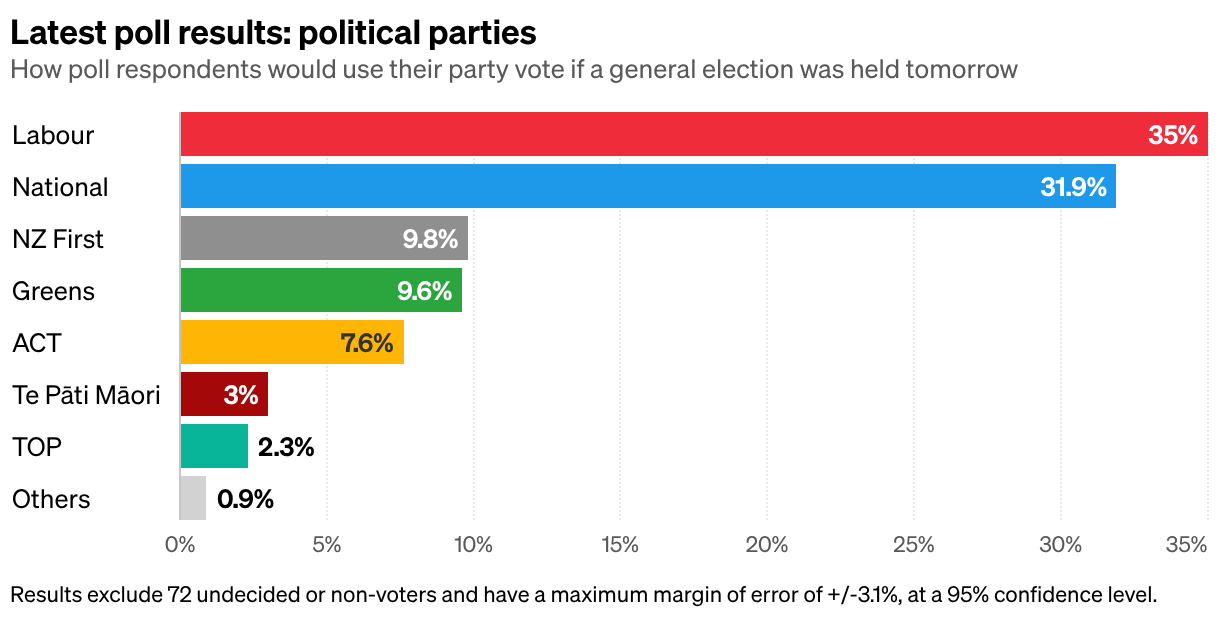
Labour remained out in front on 35 percent, up 0.7 points since September, while National slipped to 31.9 percent, down 0.6.
NZ First had the biggest bump in support, jumping 1.1 points, to hit 9.8 percent, its highest result with Reid Research since July 2017.
The Green Party fell 1.3 points to register 9.6 percent. ACT was on 7.6 percent, up 0.4 points.
And Te Pāti Māori continued its slide, falling to 3 percent, down 1.1 points.
Outside of Parliament, The Opportunity Party picked up support, climbing 0.9 points, to touch 2.3 percent.
The poll - which ran from 15-22 January - surveyed 1000 eligible voters online with a maximum margin of error of 3.1 percent. Undecided or non-voters made up 7.2 percent of those polled.
If those were the results on election day, National would bring in 40 MPs, NZ First 12 and ACT nine.
That would make 61 MPs between the current coalition parties, the slimmest possible majority in a 120-seat Parliament.
On the left, Labour would pick up 43 seats, the Greens 12 and Te Pāti Māori four. Together, that adds up to 59 MPs, not enough to claim power.
If Te Pāti Māori retained all six of its current seats, however, Parliament would have a two-seat overhang, resulting in a 61-61 deadlock.

NZ First's lift in support was mirrored in Peters' personal standing too.
On the preferred prime minister measure, Peters jumped a sizeable 3.7 points to hit 12.6 percent, his highest result in the series since January 2016.
His surge helped close the gap with the leaders of Labour and National, both of whom took a knock in support.
Labour's Chris Hipkins remained the top choice of voters, receiving the backing of 21.1 percent of voters, down 1.9 points.
National's Christopher Luxon dropped 0.2 points to 19.4 percent.
Almost 17 percent of voters declined to choose a prime ministerial candidate or said they did not know.

The poll also found an improvement in general sentiment since the lows of September, though it still remained deep in negative territory.
The results showed 36.3 percent (up 2.3) of respondents thought the country was heading in the right direction, compared to 46.6 percent (down 2.3) who thought the wrong direction.
That gives a net score of -10.3, an improvement of 3.3 points compared to the last poll in September.
Just over 15 percent of voters sat on the fence, while another 1.8 percent said they did not know.
National supporters were the most optimistic with a net score of +65.8, followed by ACT supporters on +28.2.
Notably, more NZ First voters thought the country was on the wrong track than the right track, recording a net score of -9.9.
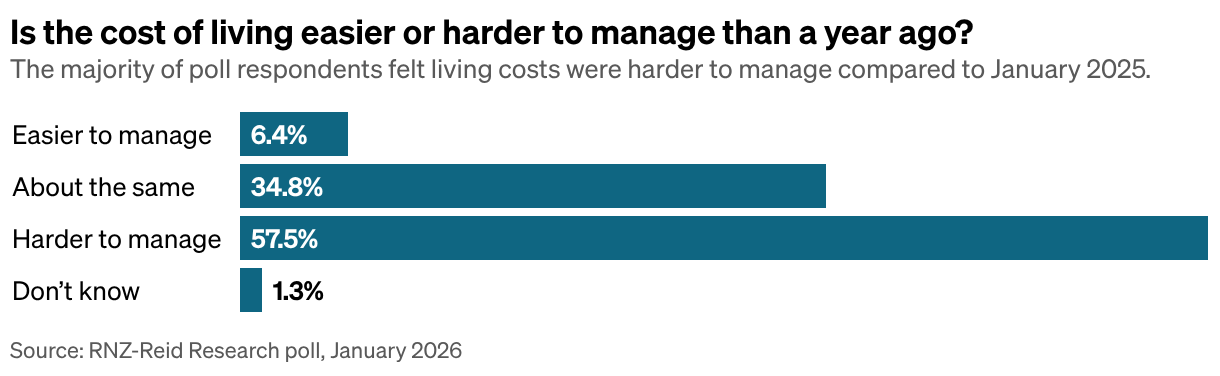
The pessimism also showed up when voters were asked to consider their financial position compared to one year ago.
Asked about the cost of living, 57.5 percent of respondents said they were finding it harder to manage than this time last year. Just 6.4 percent said they were finding it easier and 34.8 percent said "about the same".
Similarly, just 12.2 percent of voters said they felt better off financially compared to January 2025. More than 46 percent said they were worse off, while 40.1 percent said neither.

Politicians respond - or don't
Both Luxon and Peters declined interview requests from RNZ. A spokesperson for Luxon said he was prioritising the weather event situation.
Te Pāti Māori also declined to be interviewed.
Speaking to RNZ, Hipkins said he was encouraged by Labour's continued rise in the polls.
"This would suggest a neck-and-neck result," he said. "We've got a lot more work to do... but being ahead of National, being the most popular party in New Zealand, that's a good place to start election year."
Hipkins said he would not read too much into Peters' jump, saying NZ First's support was always "very volatile".

NZ First leader Winston Peters. Photo: RNZ / Samuel Rillstone
Greens' co-leader Marama Davidson said, regardless of the polls, the party would stay focused on finding solutions.
"Understandably, people are exhausted and switched off, but this November, people get to use their power and agency to demand so much more."
ACT leader David Seymour told RNZ his party started election year in a "very comfortable position" and he intended to build on it.
"We've shown that we can be effective and collegial in government... but we're also prepared to say when the emperor has no clothes."
This poll of 1000 people was conducted by Reid Research, using quota sampling and weighting to ensure representative cross section by age, gender and geography. The poll was conducted through online interviews between 15-22 January 2026 and has a maximum margin of error of +/- 3.1 percent at a 95 percent confidence level.
Sign up for Ngā Pitopito Kōrero, a daily newsletter curated by our editors and delivered straight to your inbox every weekday.