

First published on 

Olson Canatoy (inset, top) and Eric Dabalos (bottom) disappeared from Papanui Point while fishing on October 31, 2021. Photo: NZ Herald composite / NZ police / Waikato District Council
Filipino flatmates Olson Canatoy and Eric Dabalos had been warned about the dangers of fishing at Papanui Point.
They had even been nearby when another Filipino man was swept away from the notorious spot, south of Raglan.
But, despite the risks, Canatoy told a friend the pair "knew what they were doing and were able to swim".
Now their names join a list of more than 20 people who are believed to have drowned at Papanui Point after being swept away to their deaths.
On Tuesday, a coroner called for the public to be banned from the popular rock fishing spot in the hope of preventing further deaths.
But the Waikato District Council said closing Papanui Point "is not as simple as it sounds" and it is pursuing other solutions to the deadly problem.
Papanui Point, on the North Island's west coast, is regarded as one of the most dangerous places in New Zealand to fish, yet people still go there.
Water Safety New Zealand has information on 18 fatalities around Papanui Point between 1980 and 2024.
Only one was a woman. Almost half the men who died were aged from 35 to 44 and about the same proportion were of Asian descent.
None of them was wearing a lifejacket.
A search of the National Library's PapersPast newspaper archives identified three more people who were swept away in earlier years and there has been another death at the point this year.
Flatmates disappeared in 2021
Coroner Erin Woolley yesterday released her findings in the deaths of Canatoy and Dabalos, who disappeared from the point on October 31, 2021.
They were among nine people who have died in the immediate area since 2017.
Coroner Woolley said she agreed with feedback she had received from the Department of Conservation (DoC) and Surf Lifesaving New Zealand "that Papanui Point is not a safe location for continued public access".
"I endorse the steps being taken to investigate legally preventing public access to this location," she said.
"I understand this is a legally complex issue but if it is legally possible to prevent public access, this should occur."
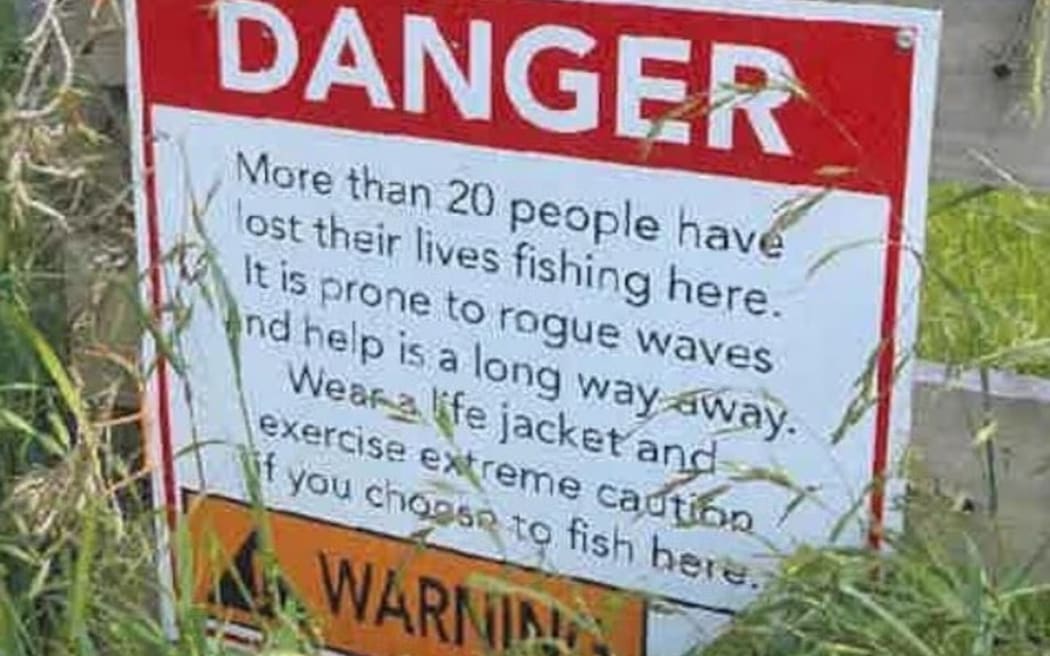
A recent warning sign tells visitors about the number of people who have died at Papanui Point. Photo: Supplied / Coroners Court
Waikato District Council said it was not pursuing a process of restricting public access to the area, although it remained one of the options to consider.
"Closing access is not as simple as it sounds," the council's open spaces services manager Glyn Morgan said.
"Waikato District Council is just one of the landowners at the site.
"We would need to work alongside other parties, such as DoC, and any access closure would require things like public consultation."
Friends describe lost men
Canatoy, 52, came from a fishing village in the Philippines and was described as cheerful and funny.
Friends said Dabalos, 44, was "one of a kind", reliable, respectful and sociable, but also quiet.

Eric Dabalos, left, and Olson Canatoy. Photo: Supplied / NZ Police
The coroner's report said both men had been working in the construction industry in New Zealand for several years, sharing a house in Temple View, Hamilton, with several other Filipino builders.
Both were family men who would frequently phone their wives and children in the Philippines.
On the day they disappeared, they left home about 5am and were expected back by 5pm or 6pm but failed to turn up.
With calls to Canatoy's phone going unanswered, their flatmates drove to the Papanui Point carpark about 9pm and found their vehicle.
It was dark and windy and waves were crashing heavily on to the rocks, so the flatmates did not go down to look for their friends.
They instead called their boss, who told them to phone the police, who began a search operation.
A blue jandal believed to belong to Canatoy was found about 500m south of the point four days later. His remains were found on 21 November and identified by his fingerprints and dental records.
An autopsy found his death was consistent with drowning, the coroner said.
Dabalos' body was never found but a pair of track pants similar to a pair he owned was discovered a few days after he disappeared.
Coroner Woolley found it was more likely than not that Dabalos also drowned on the same day as his friend.
"I cannot say how Olson and Eric came to be in the water on October 31, 2021, because there were no other witnesses who saw how this happened," the coroner said.
However, based on the conditions that day, she inferred they slipped off the rocks into the water, or they were washed off by waves, or one slipped or was washed off and the other attempted a rescue and they both drowned.
Area 'treacherous and dangerous'
The coroner said Papanui Point is a popular "but treacherous and very dangerous" rock fishing location.
"The danger of Papanui Point is due to the terrain and water conditions, which are unpredictable and unforgiving," she said.
"It is a remote, steep and exposed headland.
"A steep, sometimes slippery, access track leads to large, exposed rocks with steep slopes into the ocean below.
"Large swells, sudden surges and strong currents create hazards even in what may appear to be calm weather.
"Despite these risks, people continue to fish and explore this area of rugged coastline," Coroner Woolley said.
"Many people are familiar with the risks at this location but do not think that their time there could end in tragedy."
The coroner said Canatoy and Dabalos had been warned by their employer and flatmates about the dangers of fishing at the point.
Canatoy told one of his flatmates the pair "knew what they were doing and were able to swim". They did not wear lifejackets while fishing.
A report by Water Safety New Zealand found the drowning risk at Papanui Point was not because of a lack of awareness about the dangers of this location, or fishing inexperience.
"To the contrary, many of the people who drowned at this location were confident, experienced fishers, who were familiar with the site and in the company of other people," Coroner Woolley said.
"However, what was lacking were key safety measures, including not wearing a lifejacket, not regularly assessing the conditions and not planning for an emergency."
Council 'working towards solutions'
Morgan, from Waikato District Council, said while it was not pursuing closing the point, it was working with others towards "long-term and sustainable solutions" to the problem.
These partners included iwi, New Zealand police, Search and Rescue, DoC, Water Safety NZ, Drowning Prevention Aotearoa, Surf Life Saving NZ, Coastguard NZ and Sport Fishing New Zealand.
The council was working towards ensuring personal rescue equipment and flotation devices were accessible for anyone rock fishing in the coastal environment.
It was also working on "culturally appropriate outreach and education strategies to raise awareness and promote safer behaviour", Morgan said.
Growing list of fatalities
The deaths of Canatoy and Dabalos add their names to a growing list of people who have been lost from the point.
Doyle Frickey, 67, was seen struggling in the water by a couple in September 2017. His body was found months later.
In November the following year, Jack Macnicol, 17, was swept off the point, as was Michael Landig in November 2020. Landig was another Filipino who had come to New Zealand for a better life.
Raymond Bensig, another Filipino, and Nicolas Narayan, from Fiji, died in August 2023. Yaojun Li, 44, was swept off the rocks in January 2024.
After investigating those last three deaths, Coroner Michael Robb called for a law change to make wearing lifejackets mandatory for all rock fishers - a measure that has not been implemented.
Another man who was lost at Papanui Point in August this year has not been named publicly.
Safety advice given
Coroner Woolley repeated advice from Water Safety New Zealand about how to stay safe while rock fishing:
- Always wear a lifejacket.
- Always check the weather, severe weather warnings, coastal waters forecast and tide predictions before you leave home. Regularly check for weather updates while you're out fishing.
- Think about what your fishing spot might be like in a few hours if the weather and tides change.
- Plan an escape route in case you get washed into the water.
- Tell someone where you are going.
- Take at least two forms of communication, such as a cellphone and VHF radio.
- Pay particular attention to swell and tide information.
- Never fish in exposed areas during rough or large seas.
- Spend at least 10 minutes observing the sea conditions before approaching the rock ledge.
- Never turn your back on the sea.
- Pay attention to warning signs.
- Never fish from wet rocks where waves and spray have obviously been sweeping over them.