

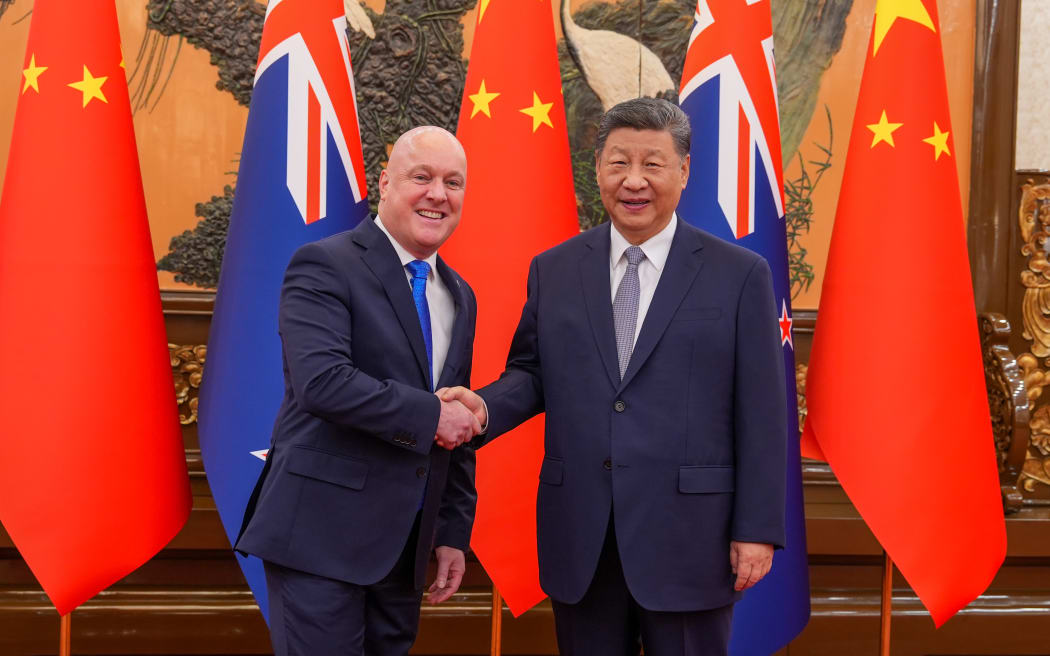
Prime Minister Christopher Luxon and Chinese President Xi Jinping in Beijing. Photo: Office of the Prime Minister
A sluggish economy, rising living costs and high unemployment rates have forced households and businesses nationwide to exercise a degree of restraint in 2025.
New Zealand's Chinese community has not been immune to such challenges, facing rising business closures, a tight job market and shrinking opportunities for migrants.
However, there have been a few bright spots throughout the year, particularly in the tourism sector.
Prime Minister Christopher Luxon visited China in June to boost bilateral trade and tourism ties, with New Zealand commencing a trial of a visa-waiver pathway for Chinese visitors travelling from Australia and Beijing granting visa-free entry for New Zealanders.
As the community looks ahead to 2026, here's a look back at the moments that have defined the past year.
Political spotlight
Prime Minister Christopher Luxon's first official visit to China drew intense interest.
The three-day trip to Shanghai and Beijing was seen as something of a litmus test for Luxon.
The trip unfolded during a volatile period in global affairs, with tensions rising between China and the United States and its Western partners.
It also came after New Zealand paused nearly $20 million in core sector support for the Cook Islands, following that country's decision to sign partnership agreements with China in February without consulting Wellington.
Asked about the timing of Luxon's visit to China, Foreign Minister Winston Peters said the decision to pause the funding was not connected to China.
Before Luxon's departure, a group of former senior politicians urged the coalition government to take a less "adversarial" stance towards China.
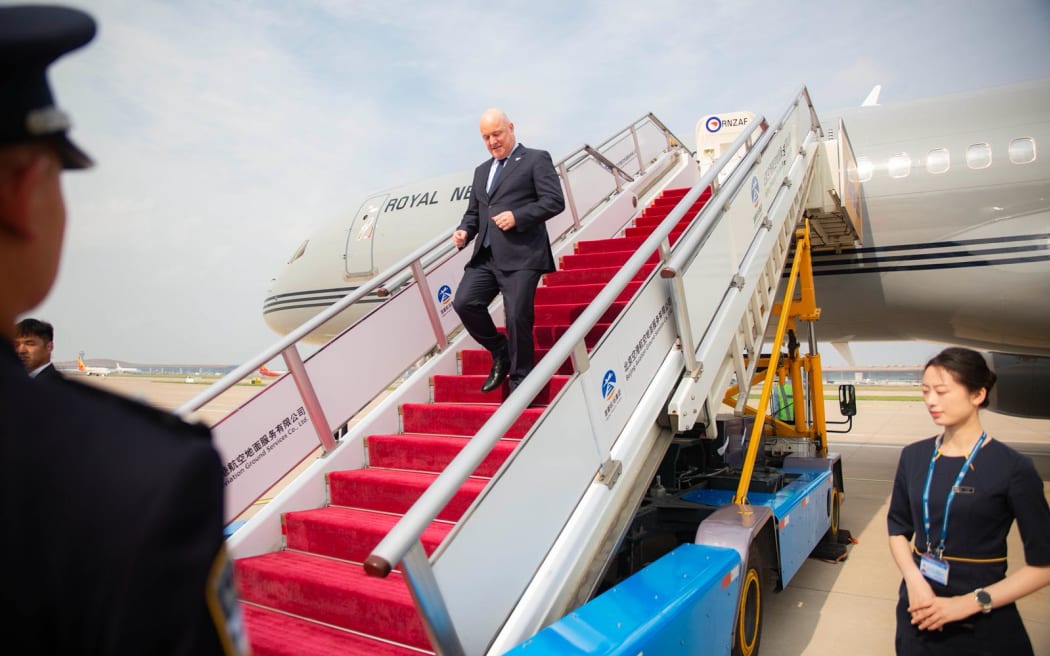
Prime Minister Christopher Luxon arrives in Beijing for a three-day visit in June. Photo: Dan Brunskill
Leaders within New Zealand's Chinese community also pressed the prime minister to broaden the agenda beyond trade and address difficult topics such as human rights and regional security.
During his meeting with President Xi Jinping, Luxon described the bilateral relationship as more important than ever at a moment of "increasing global uncertainty and strain".
The visit produced a series of business agreements and 11 new government-to-government deals.
However, the immediate impact of the visit on New Zealand's trade, tourism and education sectors is expected to take some time to assess.
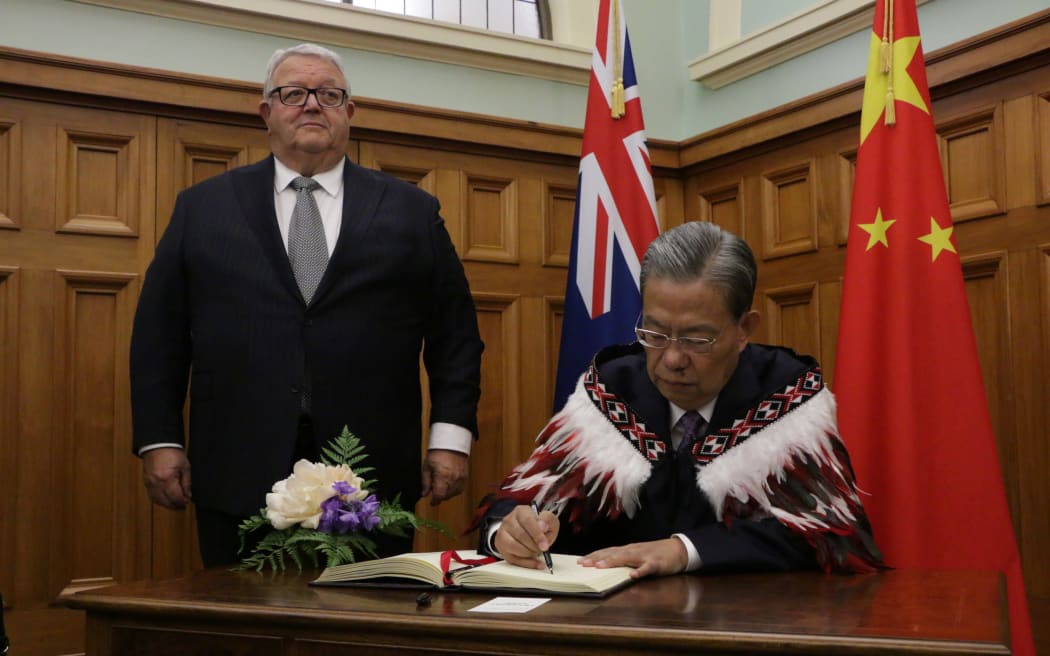
Zhao Leji, chairman of the National People's Congress Standing Committee, visited New Zealand in November. Photo: Giles Dexter
In November, China's top legislator visited New Zealand for the first time in 20 years.
Zhao Leji, chairman of China's National People's Congress Standing Committee, met Luxon in Auckland, held a bilateral meeting with speaker Gerry Brownlee in Wellington and unveiled a plaque at the opening ceremony of the Rewi Alley Memorial Museum in Christchurch.
Meanwhile, domestic politics highlighted rising diversity in representation.
In November, Qiulae Wong was named as new leader of the Opportunity party. Touted as a supporter of sustainable businesses, Wong is expected to lead the party into the 2026 election.
In local body elections, more than a dozen Asian New Zealanders secured council seats nationwide, including several first-time wins.

More than a dozen Asian New Zealanders have been elected to council seats nationwide in 2025 local body elections Photo: Supplied
In addition, nearly 30 candidates of Asian origin won seats on local and community boards nationwide.
At the same time, allegations of electoral fraud surfaced, including complaints in Auckland that voting papers had been stolen from letterboxes in the Papatoetoe area.
A separate complaint was lodged against newly elected Henderson-Massey Local Board member Susan Diao.
Police later said they had found no indicators of criminal offending after making further inquiries.

Andrew Hampton, director-general of the New Zealand Security Intelligence Service Photo: VNP/Louis Collins
Security concerns
Questions surrounding foreign interference remained prominent in 2025.
In August, New Zealand's top intelligence agency released its third annual Security Threat Environment report, which highlighted rising geopolitical instability driven by competition among major powers such as the United States and China, as well as Beijing's activities in the Indo-Pacific.
Organisations that engaged in foreign interference such as China's United Front were also highlighted in the report.
In a statement, the Chinese Embassy said the report was "rife with unfounded speculation, distortion of facts and baseless accusations against China".
Several leaders within the Chinese community stressed the importance of building understanding and resilience without scaremongering.
The intelligence agency also cautioned local governments to be alert to potential foreign interference risks linked to sister-city relationships.
Meanwhile, an online resource available in 24 languages was unveiled in April to support people who might be subject to foreign interference.

Dragonboat Restaurant was placed into liquidation in July after operating for 31 years. Photo: RNZ / Yiting Lin
Business closures
The past 12 months have been exceptionally difficult for many Asian business owners.
Several Chinese construction firms told RNZ they were struggling to stay afloat as orders dried up in a harsh economic climate, with some cutting their quotes by as much as 50 percent to secure any work they could.
Chinese restaurants have faced similar pressures.
Several long-established Cantonese restaurants in Auckland that were known for their traditional dim sum dishes went into liquidation this year.
Restaurant owners told RNZ they had been forced to slash prices simply to stay afloat.
Economist Shamubeel Eaqub said the hospitality sector had been among the hardest hit during New Zealand's prolonged recession.
Fewer job opportunities
The job market in 2025 has been harsh for workers throughout New Zealand.
The unemployment rate climbed to 5.3 percent in the three months ending September, the highest level in nearly nine years, with students reportedly struggling to find work to cover basic living costs.
Pressure has been especially acute in the tech sector.
Continued layoffs, a sluggish economy and expanded use of artificial intelligence have reshaped hiring patterns, leaving many Chinese IT professionals describing the market as a "nightmare".

The job market has been tough in New Zealand over the past 12 months. Photo: AFP
For those who lost their jobs, stigma added another layer of complexity to an already challenging situation.
Community advocates say some Asian workers avoided seeking financial assistance because of cultural pressure around joblessness.
A tight labour market has also narrowed opportunities for advancement, with many workers finding it harder to secure promotions or move to new roles.
Asian professionals, in particular, continued to face a mix of language barriers, unconscious bias and opaque career pathways that have long limited access to senior management roles in New Zealand.
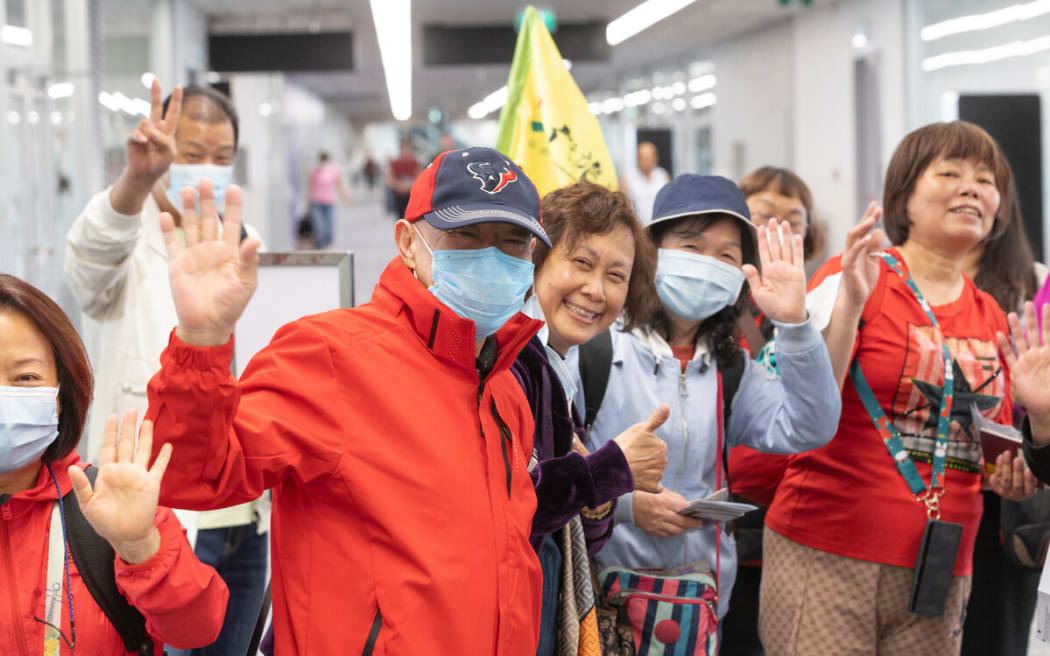
"] China was once New Zealand's second-largest source of international visitors, contributing more than $1.7 billion to the economy in 2019. Photo: Supplied / Auckland Airport
Immigration progress
A major milestone for many Chinese families in New Zealand this year was the Parent Boost Visa that was introduced by the coalition government in June.
The new visa category, which allows parents of New Zealand citizens and residents to stay for up to five years, opened for applications on 29 September and drew nearly 200 submissions in its first two weeks.
However, the surge in interest was tempered by concern over steep insurance costs.
At the same time, migrants hoping to bring parents to New Zealand permanently are watching another development closely.
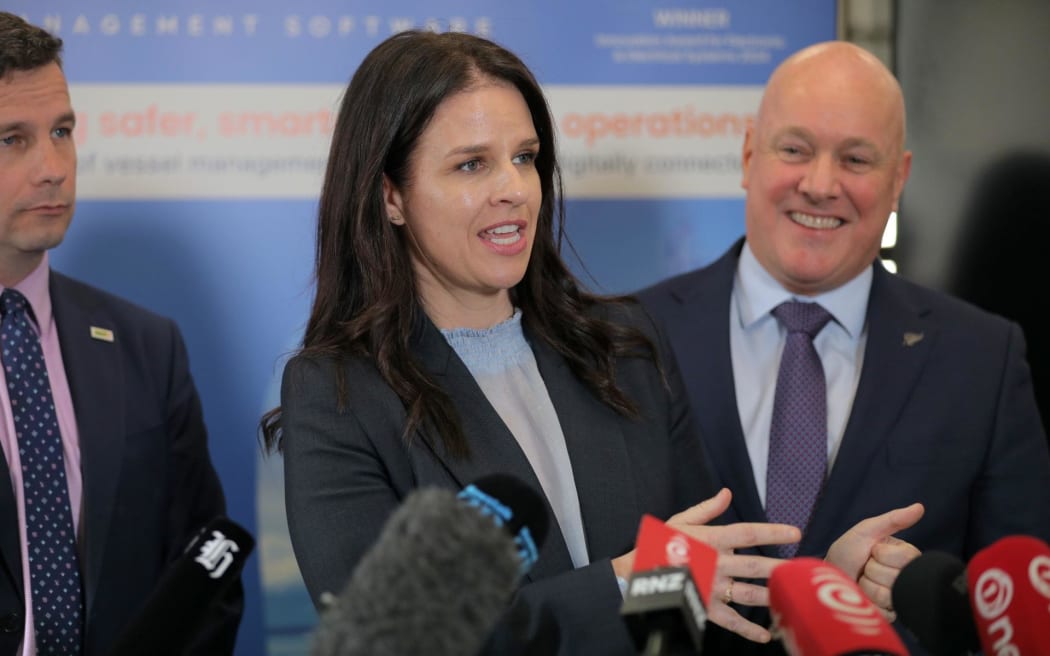
Immigration Minister Erica Stanford Photo: Nick Monro
Immigration Minister Erica Stanford has ordered an accelerated review of the allocation system for the Parent Residence Visa, acknowledging problems linked to the current ballot process.
For tourists, 2025 delivered more than one piece of good news.
China has extended its visa-free entry for New Zealand passport holders through the end of 2026.
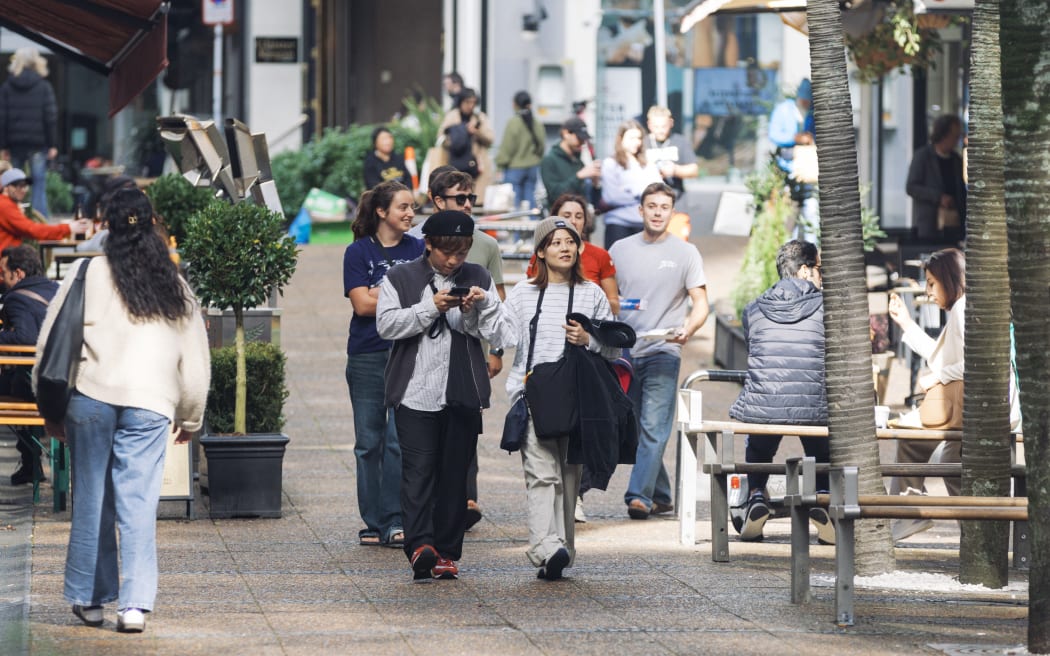
China was once New Zealand's second-largest source of international visitors, contributing more than $1.7 billion to the economy in 2019. Photo: RNZ / Yiting Lin
At the same time, New Zealand has begun trialling a visa-waiver pathway for Chinese visitors travelling from Australia.
In a move to support international education, Immigration New Zealand has also revised its student-visa settings, increasing the weekly work limit for eligible students from 20 to 25 hours.
Education overhaul
The year 2025 has brought significant changes to the country's education system.
As part of the government's first steps toward what it calls a "knowledge-rich" curriculum, new maths and English curriculums for primary school students took effect this year, a shift widely welcomed by the Chinese community.
Amid the curriculum reform, educators and language experts have renewed calls for second-language courses to become compulsory from intermediate school.
Ministry of Education data also shows a shift in language preferences in New Zealand's public schools, moving away from traditional European languages toward te reo Māori and Asian languages.
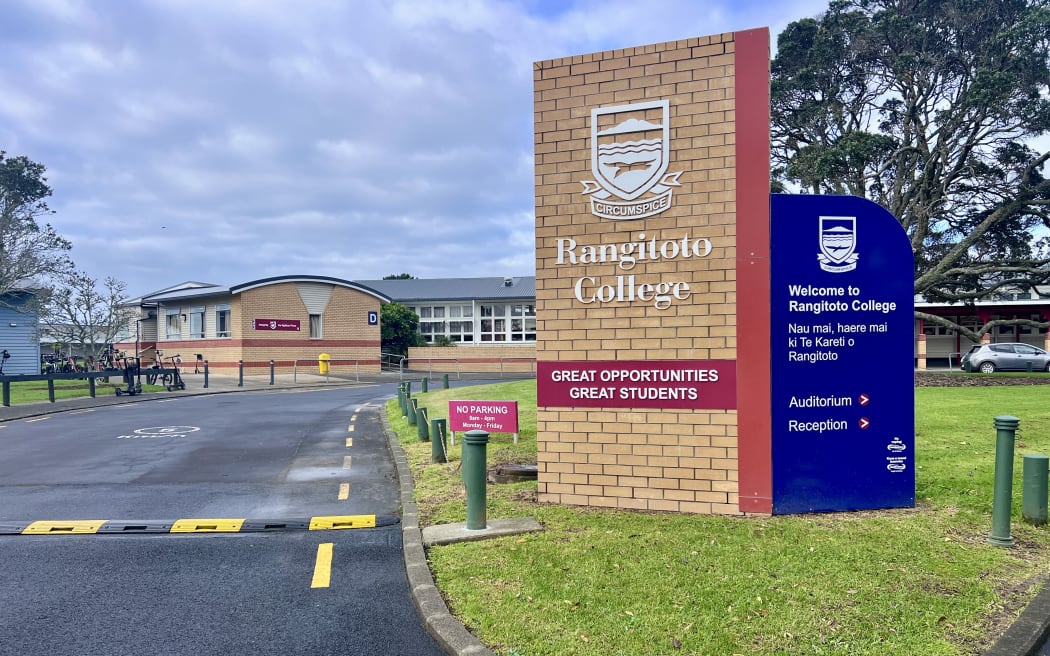
Rangitoto College on Auckland's North Shore will no longer accept out-of-zone students from 2026. Photo: Supplied
In Auckland, a surge in enrolment demand from migrant families has also drawn attention.
Rangitoto College and Mount Albert Grammar School have been forced to turn away out-of-zone applicants amid a post-pandemic influx of new arrivals.
Competition for places in Auckland's private schools has also intensified, with applicants facing an expanding list of screening tests to secure entry for 2026.

Educators and language experts have renewed calls for second-language courses to become compulsory from intermediate school. Photo: Supplied
Special mentions
Several other stories have created a few waves in the community over the past 12 months.
A beloved teacher at Takapuna Grammar School in Auckland died in a diving accident in Fiji, prompting an outpouring of tributes from the school community honoring his contributions.
Public safety also loomed large in 2025, with ethnic communities voicing concern over security at public gatherings in Auckland after two people were stabbed at the Pakuranga Night Market in June.
In June, Christchurch real estate agent Yafei Bao's killer, Tingjun Cao, was sentenced to at least 17 years in jail.
Cao has since appealed against both his conviction and sentence, arguing there had been a miscarriage of justice.

Tingjun Cao was removed from court during his sentencing for the murder of real estate agent Yanfei Bao. Photo: CHRIS SKELTON
A mistaken bank transfer involving a Chinese individual also captured attention this year.
In May, finance experts warned consumers to double-check account details when making international bank transfers after Auckland pensioner Sit Bong (Andrew) Che mistakenly transferred $158,643 from the UK early last year to the wrong account.
After the recipient refused to return the money, Che lodged complaints with the police and banks in both New Zealand and the UK.

Sit Bong (Andrew) Che mistakenly transferred $158,643 from the UK early last year to the wrong account. Photo: Supplied
Barclays Bank eventually refunded the money, but the criminal case against the recipient continues to unfold.
Another issue that drew attention in 2025 involved a growing group of Chinese parents known as peidu mama and peidu baba - mothers and fathers who relocate overseas to support their children's education.
Many had left behind careers, financial security and long-standing community ties to move to New Zealand in the hope of securing better opportunities for their children.
In sharing their stories, a wider audience gained some insight into the challenges they faced.
In February, a documentary titled Farewell Guangdong, produced for RNZ by Tawera Productions with support from NZ On Air, recounted the harrowing journey of early Chinese refugees.
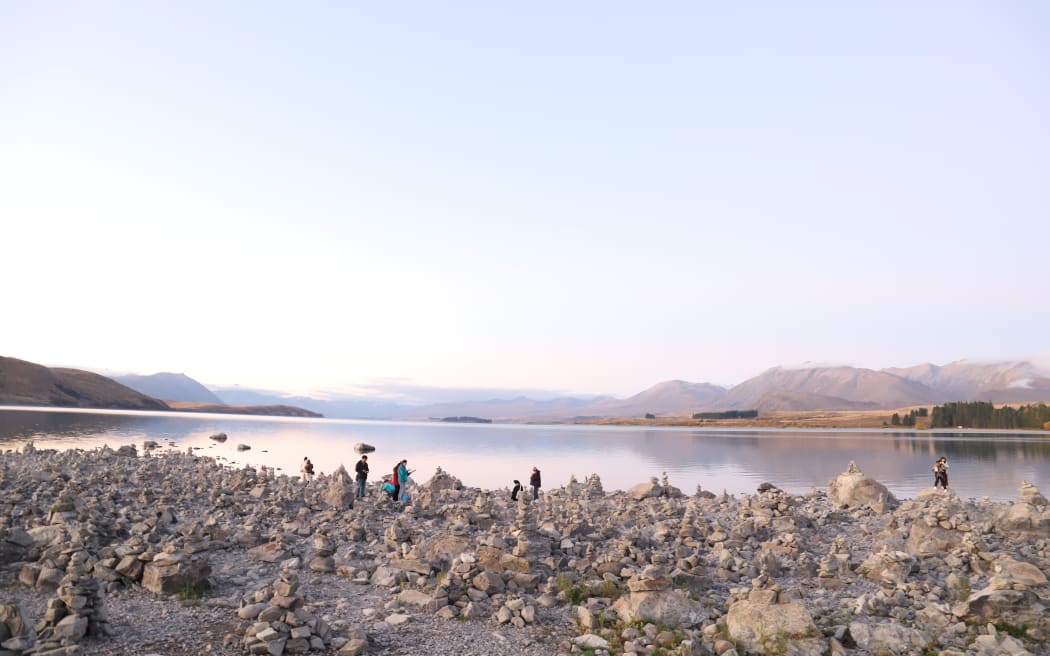
Visitors to Lake Tekapo said they believed stacking rocks was part of a local custom. Photo: Karen Jiang
Lake Tekapo in the South Island was also thrust into the spotlight in 2025.
Local residents called for a ban on visitors stacking rocks along the foreshore in May, arguing the practice threatened the natural ecosystem.
Experts are divided over whether the structures are harming the environment.
At the same time, a lost diary discovered at the lake set off an unexpected treasure hunt that continues to draw curious tourists to this day.



